
Can I Run Sea of Thieves on My PC / Laptop?
Rare's shared-world pirate game, built on a heavily customized engine that runs on modest hardware while its physically based ocean pushes much harder on strong GPUs.
Check if your PC can run Sea of Thieves
Pick your graphics card and processor to check.
Can I run Sea of Thieves on my PC?
Use the checker above to find out in seconds. Pick your graphics card and processor and it compares them against Sea of Thieves's official requirements. As a quick guide, you need at least a Nvidia GeForce GTX 660 or AMD Radeon R9 270 graphics card, a Intel i3 4170 @ 3.7 GHz or AMD FX-6300 @ 3.5 GHz processor, and 8 GB RAM of RAM to play at 1080p.
Can I run Sea of Thieves on my laptop?
Yes, if your laptop has a dedicated graphics card around a Nvidia GeForce GTX 660 or AMD Radeon R9 270 or better and 8 GB RAM of RAM. Laptops with only integrated graphics usually fall short. Enter your laptop's GPU in the tool above to check. Keep in mind that the laptop version of a card runs a little slower than the desktop card of the same name, and heat can lower sustained frame rates.
Sea of Thieves is one of the easier big-budget games to run. The official minimum asks for little more than a GTX 660 or an RX 270, cards that are over a decade old, and most laptops with any dedicated graphics chip clear it without trouble. What people get wrong is thinking that means it never gets demanding. Push the water reflections and cloud detail up during a storm and even a mid-range card feels the load, since the ocean itself is the one part of this game that never stops rendering.
Run your specs through the checker above for the official verdict. Everything after that covers the fps cap and why it can bite you, the RAM creep some players report during long sessions, and how the game holds up on Steam Deck and Linux.
Sea of Thieves system requirements
| Minimum | Recommended | |
|---|---|---|
| Processor (CPU) | Intel i3 4170 @ 3.7 GHz or AMD FX-6300 @ 3.5 GHz | Intel i7 4790 @4Ghz - AMD Ryzen 5 1600 @3.6Ghz |
| Graphics card (GPU) | Nvidia GeForce GTX 660 or AMD Radeon R9 270 | Nvidia Geforce GTX 1080ti - AMD Radeon Rx Vega 64 - Intel A750 |
| Memory (RAM) | 8 GB RAM | 16 GB RAM |
| Operating system | Windows 10 version 18362.0 or higher | Windows® 10 64-bit |
| DirectX | Version 11 | Version 12 |
| Storage | 100 GB available space | 100 GB available space |
Storage: 100 GB. An SSD is strongly recommended for load times and to avoid streaming stutter near islands, though it is not an official requirement.
Sea of Thieves FPS by graphics card
| Graphics card | 1080p | 1440p | 4K | Notes |
|---|---|---|---|---|
| Intel Iris Xe (integrated) | ~30-40 | , | , | Low settings with water and fog turned down. Storms hit this hardest. |
| GTX 1060 6GB | ~60-75 | , | , | High settings, calm seas. This is roughly the old official recommended card. |
| RX 580 | ~55-70 | , | , | Similar territory to the GTX 1060, high settings. |
| GTX 1650 | ~50-65 | , | , | Medium to high settings. Fine for a budget build. |
| RTX 2060 | ~90-110 | ~65-80 | , | Comfortable at 1080p Ultra, solid at 1440p High. |
| RTX 3060 | ~110+ | ~85-100 | , | Ultra settings hold well at both resolutions. |
| RTX 4060 | ~130+ | ~100-120 | ~60-75 | 4K Ultra is playable, though storms will dip below 60 at times. |
| RTX 4070 and up | , | ~140+ | ~90-110 | The point where storms and busy outposts stop being a concern at all. |
These are approximate ranges, not lab benchmarks. Sea of Thieves has no official third-party benchmark charts because it runs consistently well across hardware tiers, so actual numbers shift with the weather, how many ships and players are nearby, your exact settings, and your driver version.
Can these graphics cards run Sea of Thieves?
| Graphics card | Verdict | Notes |
|---|---|---|
| GTX 1050 Ti | Playable | Minimum covered. 1080p low to medium is the target. |
| GTX 1650 | Playable | Meets the bar. Low to medium settings at 1080p. |
| RX 570 | Playable | Minimum covered. 1080p low to medium is the target. |
| RX 580 | Playable | Runnable at minimum. Low to medium 1080p, ease settings back. |
| GTX 1060 6GB | Playable | Minimum covered. 1080p low to medium is the target. |
| GTX 1650 Super | Playable | Passes minimum. Aim low to medium 1080p, upscaling helps. |
| GTX 1660 | Playable | Minimum covered. 1080p low to medium is the target. |
| GTX 1660 Super | Playable | Meets the bar. Low to medium settings at 1080p. |
| RTX 3050 | Playable | Just clears it. 1080p low to medium, smoother after tuning. |
| GTX 1660 Ti | Playable | Runnable at minimum. Low to medium 1080p, ease settings back. |
| RX 6600 | Playable | Clears the minimum. 1080p low to medium, better with upscaling. |
| RTX 2060 | Runs well | Exceeds recommended. 1080p high is comfortable, 1440p fine. |
| RTX 4050 | Runs well | Beats the recommended spec. Comfortable high 1080p, playable 1440p. |
| Arc A750 | Runs well | At or above the recommended card. Smooth 1080p high, 1440p realistic. |
| RTX 3060 | Runs well | Recommended tier or better. High 1080p, with room for 1440p. |
| RX 6600 XT | Runs well | Past the recommended tier. High settings at 1080p, 1440p on the table. |
| RX 7600 | Runs well | Above recommended. 1080p high is easy, and 1440p works too. |
| RX 6700 XT | Runs well | At or above the recommended card. Smooth 1080p high, 1440p realistic. |
| RTX 4060 | Runs well | At or above the recommended card. Smooth 1080p high, 1440p realistic. |
| RTX 3060 Ti | Runs well | Recommended tier or better. High 1080p, with room for 1440p. |
| RTX 3070 | Runs well | Past the recommended tier. High settings at 1080p, 1440p on the table. |
| RTX 4070 | Runs well | Above recommended. 1080p high is easy, and 1440p works too. |
What actually decides your performance
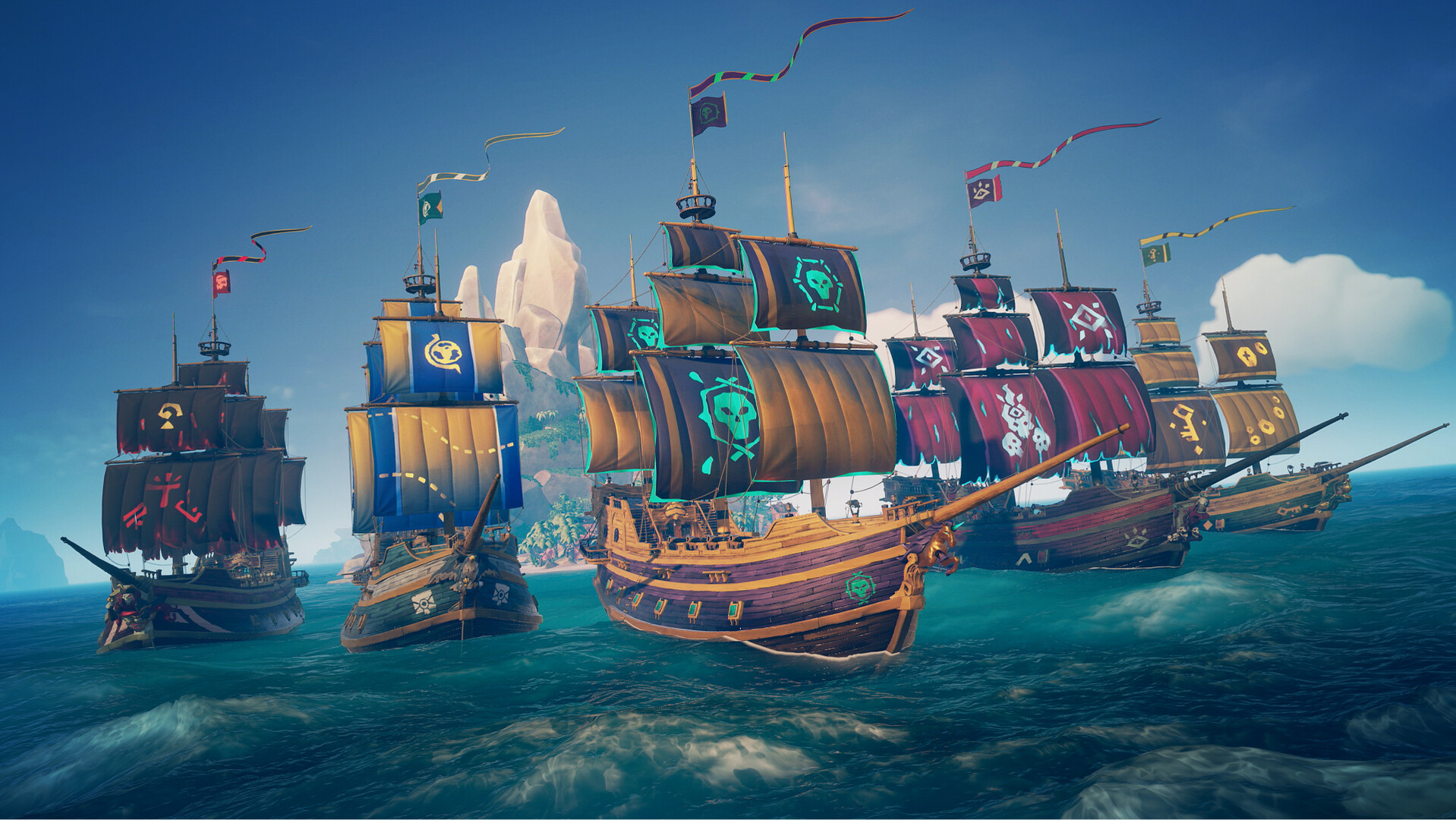
Sea of Thieves will run and run well on almost anything built in the last ten years. Rare's engine is a heavily modified, old codebase they have optimized for years specifically so it scales down to weak hardware, which is why the official minimum GPU is a GTX 660. The one part of the game that behaves differently is the ocean. Its physically based water and volumetric cloud system are the visual centerpiece, and reflections on wet ship decks and choppy water during a storm are the single biggest GPU cost in the game. Calm seas on a sunny day are cheap to render. A thunderstorm with three ships nearby is not.
So the honest answer to whether you can run it depends less on your raw GPU tier and more on whether you are willing to turn water and cloud quality down a notch during rough weather. Everything else, shadows, foliage, character detail, is comparatively light.
Frame rate: no cap on PC, and why that can bite you
The PC version has no forced fps ceiling. The in-game limiter offers 15, 30, 60, 90, 120, or unlimited, and on a fast enough rig unlimited can push well past 144 fps. That sounds like a pure win, but Sea of Thieves' own support pages warn that running fully uncapped can cause micro-stutter and rubber-banding on some systems, and the fix they recommend is capping your frame rate below 120 or matching it to your monitor's refresh rate rather than leaving it wide open.
Console players get a fixed choice instead. Xbox Series X has a Performance Mode that runs at 1080p and up to 120 fps, with a separate 4K at 60 fps mode for players who want the resolution instead. Xbox Series S and the original Xbox One target 30 to 60 fps depending on mode, and PS5 currently targets 60 fps without a confirmed 120 fps option. None of that applies to PC, where you set your own target.
RAM, storage, and the memory creep that catches people out
The official minimum used to be a flat 8GB, and Rare has since split that into 8GB minimum and 16GB recommended. Treat 16GB as the real target for a comfortable session. The reason is a known memory pattern players have reported across multiple updates: RAM usage tends to climb the longer you play, particularly across server reconnects and queue transfers, and it does not always fully release what it grabbed. Sessions that run for hours have been reported using 16 to 20GB. If you notice stutter creeping in after a long play session, closing and relaunching the game clears it.
Storage is 100GB, which is a bigger ask than the game's actual footprint would suggest, mostly from years of seasonal content and audio. An SSD is not an official requirement, but it is a real recommendation. Loading into an outpost or crossing between server regions on a spinning hard drive introduces the kind of pop-in and streaming stutter that an SSD avoids entirely. If you get persistent stutter regardless of hardware, one of the most commonly reported community fixes is switching the renderer from DirectX 12 to DirectX 11 in the video settings, or by hand-editing D3DVersion in the game's config file. It will not fix everything, but it resolves a specific class of DX12-related hitching for a lot of players.
Steam Deck, Linux, and getting it running on weak hardware
Sea of Thieves carries Valve's Steam Deck Verified badge and sits at a Gold rating on ProtonDB, meaning it runs well through Proton with only minor manual steps. It uses Easy Anti-Cheat, and Rare specifically enabled EAC's Linux mode back in March 2024 so Deck and Linux desktop players would not be locked out. The one recurring hiccup is not performance, it is sign-in. Because the game requires linking a Microsoft account, some Linux and Deck users hit a broken Xbox security prompt asking for a face, fingerprint, PIN, or security key that never opens properly outside Windows. The two workarounds people report working are installing the Microsoft Authenticator app on a phone, which intercepts the prompt, or removing passkeys from your Microsoft account's security settings entirely.
On genuinely low-end hardware, whether that is an old laptop, a budget desktop, or integrated graphics, the settings worth touching first are water quality, cloud and fog quality, and view distance. Dropping those three to low recovers most of the frame rate loss while leaving character models and ship detail largely intact, since those were never the expensive part to begin with.
Can I run Sea of Thieves? Your questions answered
8GB clears the official minimum, but long sessions tell a different story. Players have reported usage climbing to 16-20GB the longer they stay connected, so 16GB is the number that actually holds up without stutter creeping in.
For this specific game, yes. 16GB already covers even the longest sessions and the reported memory creep without trouble. Where 32GB earns its keep is when you're also streaming, recording, or running other heavy background software at the same time, not because Sea of Thieves itself asks for it.
Not officially. The listed requirements do not specify a drive type, so a hard drive will technically run the game. In practice an SSD noticeably reduces load times and cuts down on the texture pop-in and streaming stutter you get crossing between islands or server regions.
100GB. That figure covers the base install plus years of seasonal content, voice lines, and audio that have built up since 2020. Leave a bit of extra room beyond the listed number for patches.
No. The official requirement is Windows 10 version 18362.0 or higher, and Windows 11 works fine as well. You do not need to upgrade specifically for this game.
No. It is a standalone purchase on Steam and the Microsoft Store, and playing on PC does not require a paid subscription of any kind. It has historically also been included in Xbox Game Pass as a Play Anywhere title, so Game Pass subscribers get it without buying it separately, but a subscription is not required if you own the game outright.
There is only one base game. The Steam listing name gets refreshed periodically to reflect the current year of content, currently showing as Sea of Thieves: 2026 Edition, but that is the same core game rather than a separate purchase tier, and it does not change the system requirements. Cosmetic bundles exist but do not affect performance.
Start with your GPU driver, since an outdated one is behind a lot of these reports. Beyond that, an uncapped frame rate can cause more instability than it fixes, so try capping at or below 120 in the video settings, and if the game still hitches, switch the renderer from DirectX 12 to DirectX 11.
Not on PC. The in-game limiter lets you choose 15, 30, 60, 90, 120, or unlimited, so a strong system can run well past 144 fps. Sea of Thieves' own support documentation actually recommends capping below 120 rather than leaving it unlimited, since some setups see micro-stutter and rubber-banding with no cap at all.
If your specs already clear the minimum, try running the launcher as administrator, verifying game files through Steam, and updating your graphics driver. Also check that your Microsoft account link hasn't expired, since Sea of Thieves checks that connection at launch.
The official recommended tier lists DirectX 12, but the game can also run under DirectX 11, and switching to DX11 in the video settings is a common fix for stutter on certain GPU and driver combinations. Either mode will run the game.
Yes, at the lower end. With the RTX 3050 you clear Sea of Thieves's minimum, so 1080p low to medium is the target and easing back a setting helps. Roughly 60 to 80 fps at 1080p High, a solid budget laptop or desktop option for this game.
Yes, on modest settings. The GTX 1650 meets what Sea of Thieves needs at minimum, so 1080p low to medium is the sweet spot. About 50 to 65 fps at 1080p Medium to High.
You can play it. The GTX 1060 6GB is at Sea of Thieves's minimum, so keep to 1080p low to medium and lower a setting if it stutters. Around 60 to 75 fps at 1080p High on calm seas, dropping somewhat during storms with water quality maxed.
Yes, though keep expectations modest. The RX 580 clears Sea of Thieves's minimum, so plan on 1080p at low to medium and trim a setting or two for a steady frame rate. Roughly 55 to 70 fps at 1080p High, similar territory to a GTX 1060.
That is more than enough. The RTX 4060 clears Sea of Thieves's recommended requirement, so aim for high at 1080p or step up to 1440p. Over 130 fps at 1080p, 100 to 120 at 1440p, and a playable 60 to 75 at 4K Ultra.
That is more than enough. The RTX 3060 clears Sea of Thieves's recommended requirement, so aim for high at 1080p or step up to 1440p. Past 110 fps at 1080p Ultra and 85 to 100 at 1440p, holding steady even in storms.
You are well set. The RTX 2060 exceeds Sea of Thieves's recommended card, so 1080p high is easy and 1440p is realistic. Around 90 to 110 fps at 1080p Ultra, or 65 to 80 at 1440p High.
Yes, on modest settings. The GTX 1660 meets what Sea of Thieves needs at minimum, so 1080p low to medium is the sweet spot.
You can play it. The GTX 1660 Super is at Sea of Thieves's minimum, so keep to 1080p low to medium and lower a setting if it stutters. Around 75 to 95 fps at 1080p High.
The RX 6600 gets you in. It meets Sea of Thieves's minimum, so low to medium at 1080p works, and turning a couple of things down keeps it steady. About 100 to 120 fps at 1080p Ultra and 70 to 90 at 1440p High.
Fine for a lighter setup. The GTX 1660 Ti clears Sea of Thieves's minimum, so target 1080p low to medium and adjust down for a steady rate.
Yes, with room to spare. Sea of Thieves recommends less than the RTX 3060 Ti offers, so expect smooth 1080p high and a playable 1440p.
Yes. On the RTX 4050, Sea of Thieves runs at high settings in 1080p and scales up to 1440p without much fuss.
Good enough to play. The GTX 1050 Ti sits at Sea of Thieves's minimum, so expect 1080p low to medium and a bit of tuning for smoothness.
The RTX 4070 is a strong fit for Sea of Thieves. It lands at or above the recommended spec, so high 1080p is comfortable and 1440p works. Around 140 fps at 1440p Ultra and 90 to 110 at 4K, comfortable even during busy outpost fights.
Cloud streaming through GeForce Now is your most reliable path, since Sea of Thieves has no Mac build for M-series chips to run directly. An unofficial Windows layer like CrossOver is an option too, but expect it to be shaky given the game's anti-cheat and Microsoft account login requirements.
Yes, a recent integrated chip like Intel Iris Xe or AMD Radeon 780M/760M handles it at low settings, roughly 30 to 40 fps with water and cloud quality turned down. Older integrated graphics from before around 2020 will likely fall short and struggle to stay playable.
Chromebooks lack both the graphics hardware and the Windows compatibility this game needs, so local play is off the table. GeForce Now or a comparable streaming service is what actually gets it onto the screen.
Yes. Sea of Thieves carries Valve's Steam Deck Verified badge and sits at Gold on ProtonDB, meaning it plays well through Proton with only minor setup. The one recurring snag is signing into your Microsoft account, since a security prompt asking for face, fingerprint, PIN, or a security key sometimes fails to open properly on Linux. Installing Microsoft Authenticator on your phone or removing passkeys from your Microsoft account settings both fix it. ROG Ally and Legion Go run it the same way, generally at higher frame rates than the Deck given their stronger hardware.
Yes, running through Proton since there's no native build. Rare flipped on Easy Anti-Cheat's Linux compatibility mode back in March 2024 so Linux and Deck players wouldn't be locked out, and on most hardware, Proton performance lands close to native Windows.
Yes. Sea of Thieves is available on GeForce Now, which runs the game on remote hardware and streams the video to you, so your own device only needs a stable connection and enough power to decode the stream.
Yes, with an RTX 4060 or better you can hold roughly 60 to 75 fps at 4K Ultra, with storms occasionally dipping under 60. An RTX 4070 or stronger keeps 4K well above 60 even in busy weather.
An RTX 2060 or RX 6600 class card holds a steady 65 to 90 fps at 1440p High, and an RTX 3060 or better runs 1440p Ultra without much trouble.
Very little. Even the official minimum-tier hardware, a GTX 660 class card, can generally hold 60 fps at 1080p on low to medium settings, since this is one of the lighter big-budget games on the market. Anything from a GTX 1060 up clears 60 fps at high settings without much effort.
Most GPUs from the last five years handle ultra settings at 1080p without issue. Where it gets harder is a storm with several ships nearby at ultra water and cloud quality, which is the actual stress test in this game rather than the settings menu in general.
Yes, without much strain. Sea of Thieves is not a heavy texture consumer compared to most modern releases, so cards with 4GB of VRAM like a GTX 1650 or RX 570 rarely run into the stutter and texture pop-in that VRAM-hungry games cause on the same hardware.
PC through Steam and the Microsoft Store, Xbox One, Xbox Series X/S, and PS5. All of them share the same servers and support full cross-play, and Steam and Microsoft Store PC versions also support cross-save through your linked Microsoft account.
Yes. Xbox Series X has a Performance Mode running at 1080p up to 120 fps, plus a 4K at 60 fps mode. Series S targets a lower resolution with a smoother frame rate as its priority. Both run the same shared-world game as PC. This page focuses on the PC version.
Yes, since it launched on PS5 in 2024 as Rare's first-ever PlayStation release, running at up to 60 fps. You do need a free Microsoft account linked to your PSN account to play, the same as on Steam. This page focuses on the PC version.
No. Sea of Thieves skipped PS4 entirely and only released on PS5 despite running fine on the similarly aged Xbox One. There is no PS4 version and none has been announced.
No. There is no Switch version of Sea of Thieves and none has been confirmed. It remains on PC, Xbox, and PS5 only.
Yes, more easily than most current games. At the official minimum, a GTX 660 class card, an old i3 or FX-6300 CPU, and 8GB of RAM, you can expect a playable 30 fps or better at 1080p low. This is one of the more forgiving big-budget titles for older hardware.
Yes. The game is more GPU-bound than CPU-bound outside of very crowded server events, so a modern i3 or Ryzen 3 pairs fine with a mid-range GPU. Even the official minimum CPU, an aging i3 4170, still meets the baseline requirement.
It is a paid, standalone purchase, not free to play. Rare has occasionally run limited free trial weekends and it is included with an Xbox Game Pass subscription, but outside of those it needs to be bought.
Yes, on every platform including Steam and PS5. You link a free Microsoft account to your Steam, Microsoft Store, or PSN account before you can play. No paid Xbox subscription is required for this, just the free account link.
Yes, it launched on PS5 in 2024 as Rare's first game ever released on a PlayStation platform. It is not on PS4 or planned for Switch, only PS5 alongside PC and Xbox.