
Can I Run Insurgency Sandstorm on My PC / Laptop?
A grounded, squad-based tactical shooter where a strong CPU, not a strong graphics card, decides whether a full server stays smooth.
Check if your PC can run Insurgency Sandstorm
Pick your graphics card and processor to check.
Can I run Insurgency Sandstorm on my PC?
Use the checker above to find out in seconds. Pick your graphics card and processor and it compares them against Insurgency Sandstorm's official requirements. As a quick guide, you need at least a NVIDIA GeForce GTX 760 / AMD Radeon HD 7970 graphics card, a Intel Core i5-4440 (3.10GHz) / AMD FX-6300 (3.50GHz) processor, and 8 GB RAM of RAM to play at 1080p.
Can I run Insurgency Sandstorm on my laptop?
Yes, if your laptop has a dedicated graphics card around a NVIDIA GeForce GTX 760 / AMD Radeon HD 7970 or better and 8 GB RAM of RAM. Laptops with only integrated graphics usually fall short. Enter your laptop's GPU in the tool above to check. Keep in mind that the laptop version of a card runs a little slower than the desktop card of the same name, and heat can lower sustained frame rates.
Insurgency: Sandstorm is not a hard game to run. The official minimum asks for a GTX 760 or Radeon HD 7970, cards well over a decade old at this point, so almost any PC built in the last several years clears it without trouble. The part people get wrong is assuming a modern graphics card guarantees a smooth match. This is a CPU-heavy tactical shooter with up to 32 players plus AI bots sharing a map, and the processor decides your frame rate on a busy server more than the graphics card does.
Below you'll find the full minimum and recommended specs, a competitive frame rate tier, real numbers for common graphics cards, and answers to the questions people actually ask about running it well, including why turning every setting down to Low doesn't always help. Run your exact CPU and GPU through the checker above to see where you land against the official tiers.
Insurgency Sandstorm system requirements
| Minimum | Recommended | |
|---|---|---|
| Processor (CPU) | Intel Core i5-4440 (3.10GHz) / AMD FX-6300 (3.50GHz) | Intel Core i7-8700 (3.20GHz) / AMD Ryzen 7 2700 (3.20GHz) |
| Graphics card (GPU) | NVIDIA GeForce GTX 760 / AMD Radeon HD 7970 | NVIDIA GeForce GTX 980 / AMD Radeon R9 390X |
| Memory (RAM) | 8 GB RAM | 16 GB RAM |
| Operating system | Windows 10/11 (64 bits) | Windows 10/11 (64 bits) |
| DirectX | Version 11 | Version 11 |
| Storage | 40 GB available space | 40 GB available space |
Storage: 40 GB. An SSD isn't required, but it cuts load times and reduces the streaming stutter you get on busy servers.
Full performance tiers
| Tier | Target | CPU | GPU | RAM |
|---|---|---|---|---|
| Minimum | 1080p Low, roughly 30-45 fps | Intel Core i5-4440 (3.10GHz) / AMD FX-6300 (3.50GHz) | NVIDIA GeForce GTX 760 / AMD Radeon HD 7970 | 8 GB RAM |
| Recommended | 1080p High, roughly 60 fps | Intel Core i7-8700 (3.20GHz) / AMD Ryzen 7 2700 (3.20GHz) | NVIDIA GeForce GTX 980 / AMD Radeon R9 390X | 16 GB RAM |
| Competitive (100+ fps) | 1080p Low-Medium, 100+ fps | Intel Core i7-9700K / AMD Ryzen 7 3700X or newer | NVIDIA RTX 3060 / AMD RX 6600 or better | 16 GB RAM |
Insurgency Sandstorm FPS by graphics card
| Graphics card | 1080p | 1440p | 4K | Notes |
|---|---|---|---|---|
| GTX 1060 6GB | ~60-75 (High) | , | , | A capable CPU matters as much as this card for staying near the top of that range. |
| RX 580 8GB | ~55-70 (High) | , | , | Close to the GTX 1060 tier. AMD driver overhead can cost a few frames on a weak CPU. |
| GTX 1650 | ~50-60 (Medium) | , | , | Workable for casual play, though a full 32-player server can dip lower on a weak CPU. |
| RTX 3060 | ~100-130 | , | , | The GPU stops being the limit somewhere in this range. Your CPU decides how much further you go. |
| RX 6600 | ~95-120 | , | , | A similar story to the RTX 3060: a mid-range CPU caps you before this card runs out of headroom. |
| RTX 4060 | ~120-150 | , | , | Comfortably past 100 fps, though busy AI-heavy servers still lean on the CPU more than this card. |
| RTX 4070 | ~150-180 | , | , | Most players hit a CPU ceiling before this card becomes the bottleneck. |
| RTX 4090 | ~180-220 | , | , | Even here the CPU sets your ceiling. Big, bot-heavy matches can still dip into the low hundreds regardless of the GPU. |
Numbers are rough averages at 1080p and shift with the map, bot count, and how many players are on the server. Insurgency: Sandstorm leans on the CPU more than most shooters at this graphics level, so the same graphics card can post very different frame rates depending on the processor it's paired with.
Can these graphics cards run Insurgency Sandstorm?
| Graphics card | Verdict | Notes |
|---|---|---|
| GTX 1050 Ti | Playable | Passes minimum. Aim low to medium 1080p, upscaling helps. |
| GTX 1650 | Playable | Passes minimum. Aim low to medium 1080p, upscaling helps. |
| RX 570 | Playable | Just clears it. 1080p low to medium, smoother after tuning. |
| RX 580 | Playable | Passes minimum. Aim low to medium 1080p, upscaling helps. |
| GTX 1060 6GB | Playable | Passes minimum. Aim low to medium 1080p, upscaling helps. |
| GTX 1650 Super | Playable | Clears the minimum. 1080p low to medium, better with upscaling. |
| GTX 1660 | Runs well | Past the recommended tier. High settings at 1080p, 1440p on the table. |
| GTX 1660 Super | Runs well | Recommended tier or better. High 1080p, with room for 1440p. |
| RTX 3050 | Runs well | Strong fit. High settings at 1080p, 1440p within reach. |
| GTX 1660 Ti | Runs well | Beats the recommended spec. Comfortable high 1080p, playable 1440p. |
| RX 6600 | Runs well | Beats the recommended spec. Comfortable high 1080p, playable 1440p. |
| RTX 2060 | Runs well | Strong fit. High settings at 1080p, 1440p within reach. |
| RTX 4050 | Runs well | Past the recommended tier. High settings at 1080p, 1440p on the table. |
| Arc A750 | Runs well | Beats the recommended spec. Comfortable high 1080p, playable 1440p. |
| RTX 3060 | Runs well | Beats the recommended spec. Comfortable high 1080p, playable 1440p. |
| RX 6600 XT | Runs well | Over the recommended bar. Smooth high 1080p, 1440p realistic. |
| RX 7600 | Runs well | Beats the recommended spec. Comfortable high 1080p, playable 1440p. |
| RX 6700 XT | Runs well | Above recommended. 1080p high is easy, and 1440p works too. |
| RTX 4060 | Runs well | Over the recommended bar. Smooth high 1080p, 1440p realistic. |
| RTX 3060 Ti | Runs well | Past the recommended tier. High settings at 1080p, 1440p on the table. |
| RTX 3070 | Runs well | Recommended tier or better. High 1080p, with room for 1440p. |
| RTX 4070 | Runs well | Exceeds recommended. 1080p high is comfortable, 1440p fine. |
Why a good CPU matters more than a good GPU
Insurgency: Sandstorm asks little of your graphics card. What it asks for is a processor that can keep up with up to 32 players, a full roster of AI bots, gunfire, voice chat, and destruction physics happening on one map at once. That's CPU work, and it's why some players with a strong graphics card still see disappointing frame rates on a full community server.
You can see it in the official numbers themselves. The recommended tier pairs a fairly modest GTX 980 with a comparatively strong i7-8700 or Ryzen 7 2700, which tells you where New World Interactive expects the load to fall. If you're chasing a high, steady frame rate, put your money into the CPU before you upgrade the GPU.
Getting a steady frame rate on busy servers
A few in-game changes go further than a stronger graphics card. Run the game in fullscreen rather than windowed, since windowed mode caps your frame rate at your monitor's refresh rate no matter what your hardware can do. Keep Textures on High, since VRAM usage isn't a real concern in this game, but drop Shadows and Foliage to Low or Medium. Those two settings cost more frame rate than they add to how the game looks. Turning on Frame Rate Smoothing in the settings menu also helps even out the dips you get when a server fills up.
Some players add -USEALLAVAILABLECORES to the launch options in Steam, which lets the game spread its CPU work across more cores. A smaller group tries an unofficial -dx12 launch flag for a possible boost on newer graphics cards, but New World Interactive has never supported DX12 directly, and it introduces stutter for some players, so try it and drop back to the default DirectX 11 if it makes things worse. One thing you can't work around: a late-2024 update removed DLSS support, and the game never had FSR, so upscaling isn't an option here the way it is in most recent shooters. Your levers are settings, launch options, and hardware.
VRAM, storage, and platform quirks that trip people up
Graphics memory isn't the bottleneck it is in a lot of newer games. The official minimum GPUs carry only about 2 to 3GB of VRAM, and even at High textures on a full 32-player map, this game doesn't come close to maxing out a modern 6GB or 8GB card. Storage is a similar story: it needs 40GB of space, and while an SSD isn't mandatory, it shortens load times and smooths out the texture streaming that causes brief stutters when a new part of the map loads in.
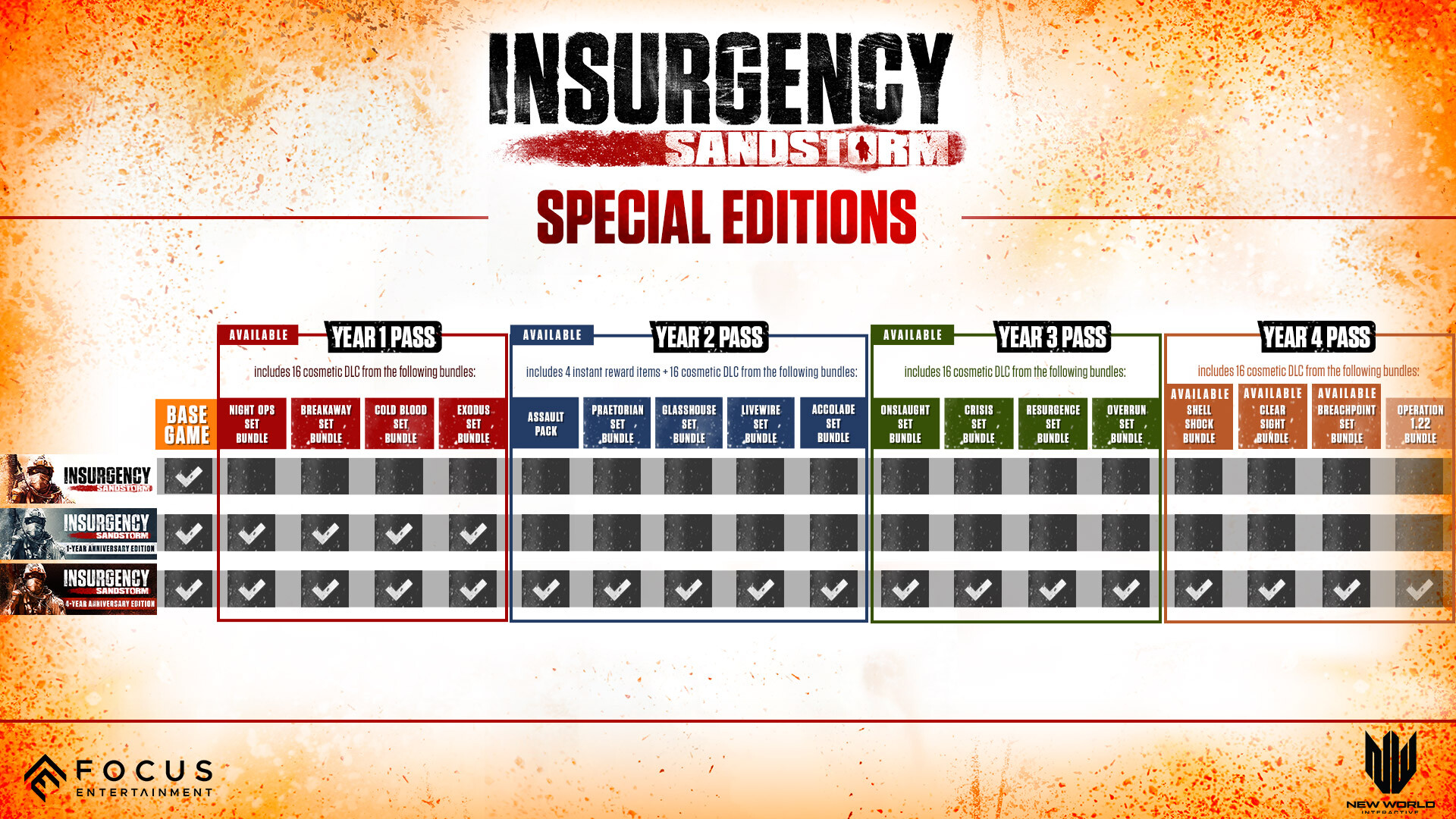
There's no native Linux build, but it runs through Steam Proton, and Easy Anti-Cheat has occasionally caused connection issues on Linux, including on Steam Deck, so check ProtonDB before relying on it as your only way to play. Crossplay arrived with the Operation: Resurgence update, so PC, PS4, PS5, Xbox One, and Xbox Series X/S players can now share the same lobbies, though your progress doesn't fully carry over if you switch between platform families.
Can I run Insurgency Sandstorm? Your questions answered
The minimum ask is only a GTX 760 or Radeon HD 7970 paired with an i5-4440 or FX-6300, hardware well over a decade old at this point, so almost any PC bought in the last five or six years clears it with room to spare. Compare your exact CPU and GPU with the checker above to be sure.
8GB clears the official minimum, though 16GB is the recommended amount and the more realistic target if you want to avoid stutter, especially with a browser or Discord open in the background. Sticking with 8GB is workable if that's genuinely all you have.
Yes, for this game specifically. 16GB comfortably covers even the recommended tier. Extra RAM beyond that won't raise your frame rate here; it only helps if you're running a lot else alongside it.
No, it isn't a requirement, and the official specs don't list one. It's still a good idea, since it cuts load times and reduces the brief stutters you get when the game streams in a new part of the map.
40GB of free space, the same figure for both the minimum and recommended tiers. Leave a bit of extra room for updates.
Not officially. The game runs on DirectX 11 by default, and while some players add an unofficial -dx12 launch flag for a possible boost on newer cards, New World Interactive has never supported it directly, and it can introduce stutter. Try DirectX 11 first.
No longer for DLSS, and it never had FSR. A late-2024 update removed DLSS support entirely, so upscaling isn't an option here the way it is in most recent shooters. Your frame rate options come down to settings, launch flags, and the resolution scale slider.
Yes, since the Operation: Resurgence update added global crossplay. PC (Steam, Epic, Microsoft Store), PS4, PS5, Xbox One, and Xbox Series X/S players can all join the same lobbies now. Progress doesn't fully carry over between platform families, though it does carry within the same console generation.
Look at single-thread CPU performance first, since this game leans on the processor more than its modest GPU requirement would suggest, and a CPU that's fine on paper can still be the weak link. From there, check that you're not running in windowed mode, since that caps your fps at your refresh rate, that Easy Anti-Cheat hasn't hung on startup, and that your drivers are current.
Usually it's texture and shader streaming as new parts of a map load in, worse on a hard drive or during the first few matches after an update, before the shader cache builds back up. It can also spike when a full 32-player server has a lot of AI bots and gunfire on screen at once, since that's CPU work, not GPU work.
Because a lot of this game's frame rate cost is CPU-side, not GPU-side, dropping every setting to Low can shift more work onto the CPU and leave your fps about the same or even lower. Try keeping Textures on High and only lowering Shadows and Foliage, the two settings that cost the most for what they add.
Yes, more than its graphics requirements suggest. The recommended tier pairs a fairly modest GTX 980 with a comparatively strong i7-8700 or Ryzen 7 2700, which tells you where New World Interactive expects the load to fall. Large servers with more players and bots push that further.
Aim for something in the Core i7-9700K or Ryzen 7 3700X class or newer. Pair it with an RTX 3060, RX 6600, or better and you'll be GPU-limited well above 100 fps at 1080p on Low to Medium settings, with the CPU deciding how much further you can push it.
Yes. It's required to join most official and community servers, and it's also the main reason Linux and Steam Deck support has been inconsistent, since Easy Anti-Cheat doesn't officially support Proton for this game.
No, it's a paid game, priced in the neighborhood of $30 on Steam, though it goes on sale regularly. It isn't part of any free-to-play shooter lineup.
100% matches your native resolution and is the safe default. If your GPU has headroom to spare, raising it to 120% to 150% sharpens the image at a real but modest fps cost, and it's worth trying before you reach for ultra settings elsewhere.
Yes. An 8-player Checkpoint match is noticeably lighter than a full 32-player Push or Skirmish match with bots filling out the server. If you're mainly playing large community servers, lean toward the stronger end of the CPU recommendations rather than the minimum.
No. It's a 2018 Unreal Engine 4 game built for competitive multiplayer rather than visual showcase features, so there's no ray tracing mode to turn on.
It's lighter than something like Squad, which is notorious for needing a strong CPU just to hold 60 fps on a full server, but it's heavier on the CPU than a lot of other games with similarly modest GPU requirements. It's an easy game to launch and a harder one to run at a rock-solid high frame rate.
For sure. The RTX 3050 outpaces Insurgency Sandstorm's recommended card, leaving you high 1080p now and 1440p whenever you like.
Yes. Insurgency Sandstorm runs on the GTX 1650 at 1080p low to medium; shave a setting or two and the frame rate settles. About 50 to 60 fps at 1080p Medium. Fine for casual play, though a full 32-player server can dip below that on a weak CPU.
It will run. The GTX 1060 6GB meets Insurgency Sandstorm's minimum, which means 1080p on low to medium and a smoother result once you lower a couple of options. Around 60 to 75 fps at 1080p High. A capable CPU matters just as much as this card for staying near the top of that range.
Playable, yes. The RX 580 passes Insurgency Sandstorm's minimum bar, so aim for low to medium at 1080p and drop settings if the frame rate dips. Roughly 55 to 70 fps at 1080p High, close to the GTX 1060 tier, with AMD's driver overhead costing a few frames on a weaker CPU.
Yes. The RTX 4060 has headroom over Insurgency Sandstorm's recommended card, so you can push 1080p high and move to 1440p when you want. Around 120 to 150 fps at 1080p. Comfortably past 100 fps, though large AI-heavy servers still lean on the CPU more than this card.
Yes. On the RTX 3060, Insurgency Sandstorm runs at high settings in 1080p and scales up to 1440p without much fuss. Around 100 to 130 fps at 1080p. The GPU stops being your limit somewhere in this range, and your CPU decides how much further you go.
The RTX 2060 is a strong fit for Insurgency Sandstorm. It lands at or above the recommended spec, so high 1080p is comfortable and 1440p works. Around 80 to 100 fps at 1080p High, a solid step up from the GTX 1060 tier and enough for a steady 60 fps with margin to spare.
The GTX 1660 is a strong fit for Insurgency Sandstorm. It lands at or above the recommended spec, so high 1080p is comfortable and 1440p works.
The GTX 1660 Super is a strong fit for Insurgency Sandstorm. It lands at or above the recommended spec, so high 1080p is comfortable and 1440p works.
That is more than enough. The RX 6600 clears Insurgency Sandstorm's recommended requirement, so aim for high at 1080p or step up to 1440p. Similar to the RTX 3060, around 95 to 120 fps at 1080p, with a mid-range CPU capping you before this card runs out of headroom.
For sure. The GTX 1660 Ti outpaces Insurgency Sandstorm's recommended card, leaving you high 1080p now and 1440p whenever you like.
Comfortably, yes. The RTX 3060 Ti clears Insurgency Sandstorm's recommended bar, which puts high 1080p and 1440p both in reach.
Yes. The RTX 4050 has headroom over Insurgency Sandstorm's recommended card, so you can push 1080p high and move to 1440p when you want.
Yes. Insurgency Sandstorm runs on the GTX 1050 Ti at 1080p low to medium; shave a setting or two and the frame rate settles.
That is more than enough. The RTX 4070 clears Insurgency Sandstorm's recommended requirement, so aim for high at 1080p or step up to 1440p. Around 150 to 180 fps at 1080p, well into CPU-limited territory for most processors paired with it.
No Mac build exists for Insurgency: Sandstorm, which rules out an M-series MacBook running it on its own hardware. GeForce Now is officially supported here and is the practical route, working well as long as your connection holds up.
Older integrated graphics will fall short, since even the minimum GPU tier (GTX 760 / HD 7970 class) is well above what most integrated chips deliver. Newer integrated graphics like Radeon 780M or Intel Iris Xe can manage Low settings at 1080p, but the CPU side of this game will still be the harder limit either way.
Chromebooks aren't built to run Windows games directly, so cloud streaming is the way in. GeForce Now handles it well, provided your Chromebook can run a browser and your connection is solid.
Yes, all three, though results vary. Steam Deck runs it through Proton at around 60 to 70 fps at roughly 900p with tuned settings, and Easy Anti-Cheat has occasionally caused connection issues on Linux, so check ProtonDB before you rely on it. ROG Ally and Legion Go run Windows natively and handle it more comfortably thanks to their stronger APUs.
Yes, and it's not particularly demanding at 4K compared to newer AAA games. An RTX 3070 or RX 6800 class card and up holds a smooth frame rate at 4K High settings, since this game's engine is more CPU-bound than GPU-bound at any resolution.
Yes. An RTX 3060 or RX 6600 handles 1440p at High settings well, and stronger cards mainly buy a higher frame rate ceiling rather than unlocking new settings, since the game isn't especially GPU-heavy at this resolution either.
The official recommended tier, an i7-8700 or Ryzen 7 2700 with a GTX 980 or R9 390X and 16GB of RAM, holds 60 fps at 1080p High on a typical match. Busy 32-player servers can dip below that on the CPU side even with a stronger GPU.
There isn't a distinct Ultra preset the way some games have one; High is effectively the top of the visual settings. Any GPU at or above the recommended GTX 980 / R9 390X handles the highest settings fine, since the bigger question for this game is always your CPU, not how far you can push the graphics.
Not much by modern standards. Even 4GB is enough for High textures at 1080p, and 6GB or more gives comfortable headroom at 1440p and 4K. This isn't a game where graphics memory is what holds you back.
Yes. It runs natively on Xbox Series X and S at up to 4K 60 fps, plus an older Xbox One version, and it supports crossplay with PC and PlayStation. This page focuses on the PC version.
Yes to both. The PS5 version runs natively at up to 4K 60 fps, the PS4 version is the older, more limited build, and both support crossplay with PC and Xbox. This page focuses on the PC version.
Within reason, yes. At the minimum of a GTX 760 or HD 7970, an i5-4440 or FX-6300, and 8GB of RAM, you can play 1080p Low at around 30 to 45 fps depending on server size. Below that hardware, look at cloud streaming instead.
It's below the official minimum CPU tier, and that's a bigger risk here than in most games given how CPU-heavy Insurgency: Sandstorm is for its graphics requirements. It might scrape by in small matches with few bots, but expect noticeable dips on a full 32-player server. Core i5 or Ryzen 5 class is a safer floor.
No, there's no Switch version of Insurgency: Sandstorm. It's on PC, PlayStation, and Xbox only.
A native Linux build was never made, so Proton is what carries it there instead. Most players get it running without much fuss, though Easy Anti-Cheat has been inconsistent on Linux for this particular game, so it's worth checking current reports on ProtonDB before you commit to it as your main platform.
Yes. It's officially supported on GeForce Now, including the free tier, and it also shows up on a few other cloud services. That's a solid option if your own hardware falls short of the minimum.