
Can I Run Helldivers 2 on My PC / Laptop?
A four-player co-op shooter where the frame rate lives and dies by your CPU, not your graphics card, once the swarms show up.
Check if your PC can run Helldivers 2
Pick your graphics card and processor to check.
Can I run Helldivers 2 on my PC?
Use the checker above to find out in seconds. Pick your graphics card and processor and it compares them against Helldivers 2's official requirements. As a quick guide, you need at least a NVIDIA GeForce GTX 1050 Ti or AMD Radeon RX 470 graphics card, a Intel Core i7-4790K or AMD Ryzen 5 1500X processor, and 8 GB RAM of RAM to play at 1080p.
Can I run Helldivers 2 on my laptop?
Yes, if your laptop has a dedicated graphics card around a NVIDIA GeForce GTX 1050 Ti or AMD Radeon RX 470 or better and 8 GB RAM of RAM. Laptops with only integrated graphics usually fall short. Enter your laptop's GPU in the tool above to check. Keep in mind that the laptop version of a card runs a little slower than the desktop card of the same name, and heat can lower sustained frame rates.
Helldivers 2 looks cartoonish, so people assume it is light. It is not. A GTX 1050 Ti clears the official minimum for 1080p on low, but the thing that actually decides your experience is your processor. The game runs on Arrowhead's own engine and has to track dozens of enemies, ragdolls, and particle effects at once, so in a busy four-player firefight the load lands on your CPU and the frame rate drops hard, even on a strong graphics card.
That is why two people with the same GPU can have very different results: the one with the older or weaker CPU stutters in the big fights. The checker above compares your exact parts against the requirements. Below you will find the full spec tiers, real frame rates for common cards, the reason it stutters in swarms, and the settings that claw the most frames back.
Helldivers 2 system requirements
| Minimum | Recommended | |
|---|---|---|
| Processor (CPU) | Intel Core i7-4790K or AMD Ryzen 5 1500X | Intel Core i7-9700K or AMD Ryzen 7 3700X |
| Graphics card (GPU) | NVIDIA GeForce GTX 1050 Ti or AMD Radeon RX 470 | NVIDIA GeForce RTX 2060 or AMD Radeon RX 6600XT |
| Memory (RAM) | 8 GB RAM | 16 GB RAM |
| Operating system | Windows 10 | Windows 10 |
| DirectX | 11 | 11 |
| Storage | 135 GB available space | 40 GB available space |
Storage: 135 GB, closer to 150 GB once updates land. An SSD is recommended.
Full performance tiers
| Tier | Target | CPU | GPU | RAM |
|---|---|---|---|---|
| Minimum | 1080p Low, 30 fps | i7-4790K / Ryzen 5 1500X | GTX 1050 Ti / RX 470 | 8 GB |
| Recommended | 1080p High, 60 fps | i7-9700K / Ryzen 7 3700X | RTX 2060 / RX 6600 XT | 16 GB |
| High 1440p | 1440p High, 60 fps | Ryzen 5 5600 / i5-12400 | RTX 3060 Ti / RX 6700 XT | 16 GB |
| 4K | 4K High, 60 fps | Ryzen 7 5800X3D / i7-12700K | RTX 4070 / RX 6800 XT | 16 GB |
Helldivers 2 FPS by graphics card
| Graphics card | 1080p | 1440p | 4K | Notes |
|---|---|---|---|---|
| GTX 1050 Ti 4GB | ~25-35 (Low) | , | , | The official minimum card. Its 4GB keeps textures low, and big fights dip into the 20s. |
| GTX 1060 6GB / RX 580 | ~35-50 (Medium) | , | , | Fine solo, but swarms and heavy stratagem spam drop it toward 30. |
| RTX 2060 | ~45-60 | , | , | Around the recommended level. A weak CPU, not this card, is what stutters here. |
| RTX 3060 12GB | ~50-65 | ~40-50 | , | Its 12GB of VRAM is comfortable. Turn on DLSS for a steadier 60. |
| RTX 4060 | ~55-70 | ~45-55 | , | DLSS Quality pushes 1080p well past 60 outside the worst fights. |
| RTX 3060 Ti / RX 6700 XT | ~65-80 | ~50-60 | , | A good 1440p card. Frame rate is capped by the CPU in the biggest battles. |
| RTX 4070 | ~85-100 | ~65-80 | ~45-55 | Comfortable at 1440p High. 4K wants DLSS Quality to hold 60. |
| RTX 4090 | ~140+ | ~110 | ~75-90 | CPU-limited at 1080p, so a faster processor helps more than this GPU can. |
These are rough averages at High with a mid-range or better CPU. Helldivers 2 swings a lot by scene: a quiet planet reads far higher than a four-player extraction with a bug breach on screen, where numbers can fall 30 to 40 percent. Your CPU, settings, and driver all move the result, and DLSS or FSR on Quality adds frames on top.
Can these graphics cards run Helldivers 2?
| Graphics card | Verdict | Notes |
|---|---|---|
| GTX 1050 Ti | Playable | Clears the minimum. 1080p low to medium, better with upscaling. |
| GTX 1650 | Playable | At the minimum bar. 1080p low to medium, drop a setting if needed. |
| RX 570 | Playable | Minimum covered. 1080p low to medium is the target. |
| RX 580 | Playable | Meets the bar. Low to medium settings at 1080p. |
| GTX 1060 6GB | Playable | Meets minimum. Low to medium at 1080p, tune for a steady rate. |
| GTX 1650 Super | Playable | Meets the bar. Low to medium settings at 1080p. |
| GTX 1660 | Playable | Runnable at minimum. Low to medium 1080p, ease settings back. |
| GTX 1660 Super | Playable | Clears the minimum. 1080p low to medium, better with upscaling. |
| RTX 3050 | Playable | At the minimum bar. 1080p low to medium, drop a setting if needed. |
| GTX 1660 Ti | Playable | Minimum covered. 1080p low to medium is the target. |
| RX 6600 | Playable | Minimum covered. 1080p low to medium is the target. |
| RTX 2060 | Runs well | Strong fit. High settings at 1080p, 1440p within reach. |
| RTX 4050 | Runs well | Strong fit. High settings at 1080p, 1440p within reach. |
| Arc A750 | Runs well | Over the recommended bar. Smooth high 1080p, 1440p realistic. |
| RTX 3060 | Runs well | Above recommended. 1080p high is easy, and 1440p works too. |
| RX 6600 XT | Runs well | Recommended tier or better. High 1080p, with room for 1440p. |
| RX 7600 | Runs well | Above recommended. 1080p high is easy, and 1440p works too. |
| RX 6700 XT | Runs well | Recommended tier or better. High 1080p, with room for 1440p. |
| RTX 4060 | Runs well | Strong fit. High settings at 1080p, 1440p within reach. |
| RTX 3060 Ti | Runs well | Strong fit. High settings at 1080p, 1440p within reach. |
| RTX 3070 | Runs well | Over the recommended bar. Smooth high 1080p, 1440p realistic. |
| RTX 4070 | Runs well | At or above the recommended card. Smooth 1080p high, 1440p realistic. |
Why it stutters and drops frames in big fights
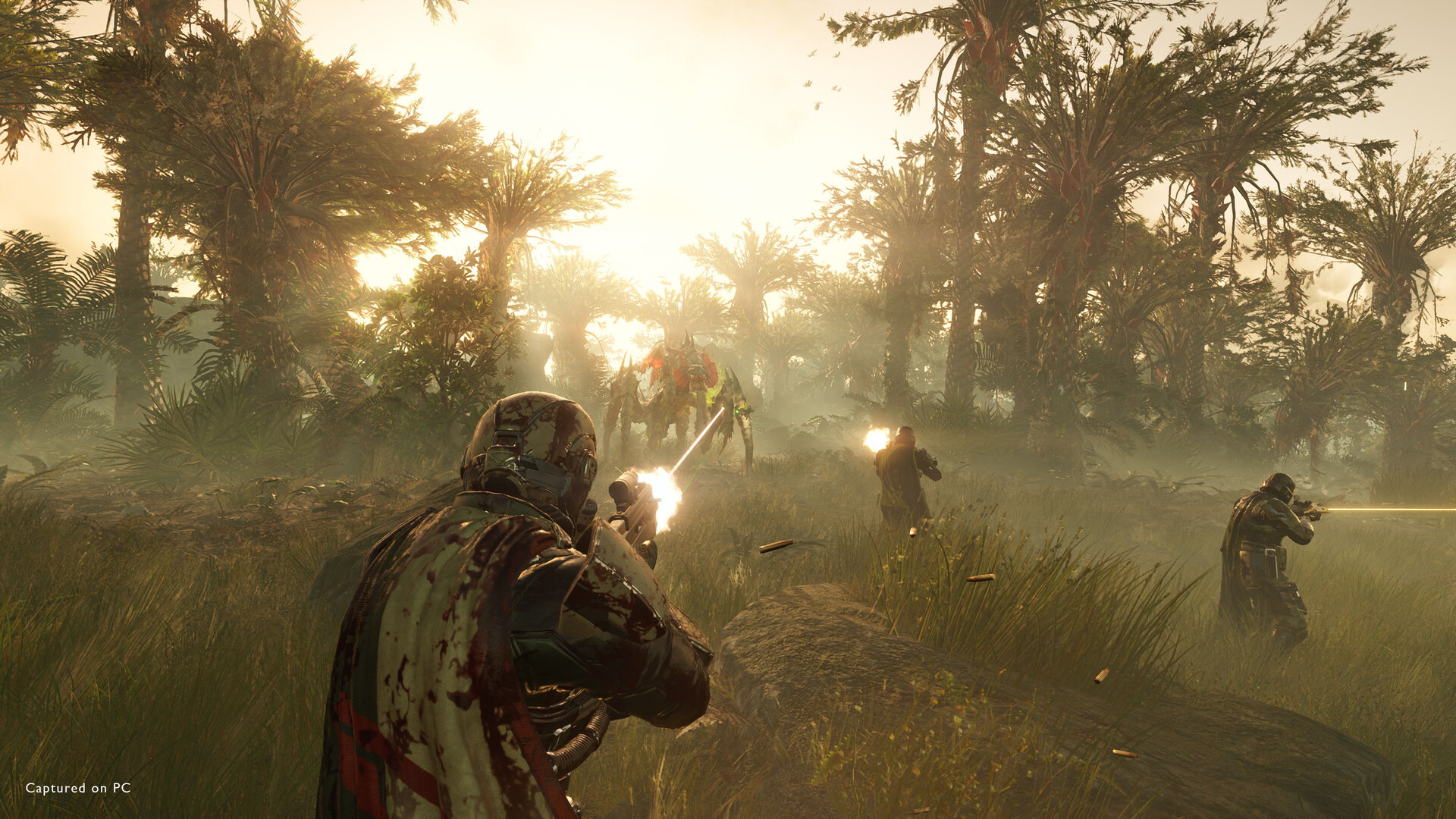
This is the one thing that decides the game. Helldivers 2 is CPU-bound in combat. On an empty map your processor barely works and the frame rate is high, but the moment a swarm spawns and stratagems, ragdolls, and particle effects pile up, the CPU jumps to full load and the frame rate falls off. Players report a Ryzen 5 5600 sitting near 150 fps on a clear map, then dropping to around 60 the second the enemies attack. Lowering your graphics settings does little here, because the graphics card was never the bottleneck.
Two things drive the load: the sheer amount of simulation the engine runs during a firefight, and the anti-cheat that runs alongside it. That is why a modern six-core or eight-core CPU matters more than the box art suggests, and why an older quad-core stutters even paired with a strong GPU. If your frame rate craters only during the chaos and is fine otherwise, that is the CPU, and it is normal for this game.
Settings that actually recover frames
Since the drops are CPU-driven, target the settings that ease the processor first. Particle Quality is the big one, so drop it to Low. Then lower Render Distance and Object Detail Quality, and pull Vegetation and Rubble Density down, which also cuts the streaming load. These do more in a real fight than shadows or textures.
Async Compute is a toggle worth testing rather than trusting. It shifts some work from the CPU onto the GPU, which can help if your processor is the limit and your card has spare headroom. On plenty of setups, though, it costs up to 20 percent, so switch it on, play a hectic mission, and keep it only if it clearly helps. After that, turn on upscaling: DLSS on GeForce RTX cards, FSR on almost anything, or XeSS on Intel Arc. Quality mode is close to free frames when the GPU is the limit.
VRAM, RAM, and storage
The official minimum is 8GB of system RAM, but 16GB is the real target. On 8GB you will see more stutter, and this is a game you play in long sessions with a browser and voice chat open. Note that 8GB of RAM and 8GB of graphics memory (VRAM) are different things people mix up.
For VRAM, 4GB cards like the GTX 1050 Ti or GTX 1650 run the game but force low textures and hitch in dense scenes. 6GB is more comfortable, and 8GB or more lets you run High textures without worry. On storage, keep around 135GB free, closer to 150GB after updates. An SSD is not strictly required but it is worth it, because it cuts load times and reduces the streaming stutter when a mission starts.
One more thing that trips people up: Helldivers 2 needs a steady internet connection at all times, solo included, so there is no offline mode and no split screen. The game runs on nProtect GameGuard anti-cheat, which is required to play; on Steam Deck and Linux it works through Proton without kernel-level access, so it does not lock those platforms out. On the graphics side it defaults to DirectX 12, though a launch option can force DirectX 11 if that runs smoother on your setup. There is no official Vulkan support.
Can I run Helldivers 2? Your questions answered
Because it is CPU-bound in combat. When a swarm spawns and stratagems and effects pile up, the load lands on your processor, not your graphics card, and the frame rate falls. A modern six-core or eight-core CPU handles this far better than an older quad-core. Lowering graphics settings barely helps, so ease the CPU instead: drop Particle Quality and Render Distance.
Both, but the CPU is what decides your experience in a firefight. Quiet moments lean on the GPU, while big battles hammer the CPU. This is why a strong graphics card still stutters in swarms if it is paired with a weak processor.
Yes, if it is a reasonably modern i5. A six-core i5-10400, i5-12400, or newer runs it well. Older four-core i5 chips clear the menu but struggle in the busy fights where the game is CPU-bound. A Ryzen 5 3600 or 5600 is a good equivalent.
It moves some work from the CPU to the GPU. If your processor is the bottleneck and your graphics card has spare power, it can help. On many setups it costs up to 20 percent instead, so test it in a hectic mission and keep it only if it clearly improves things.
It meets the official minimum, but 16GB is the real target. On 8GB you get more stutter, especially in long sessions with a browser or voice chat open. 16GB is inexpensive and makes the game smoother.
4GB runs it but forces low textures and hitches in dense scenes. 6GB is more comfortable, and 8GB or more lets you run High textures without worry. VRAM is less of a limiter here than the CPU is.
It is not strictly required, but recommended. An SSD cuts load times and reduces the streaming stutter at the start of a mission. A hard drive works but is a slower, hitchier experience.
Around 135GB, and closer to 150GB after updates. Keep some extra space free for patches, and install it on an SSD if you can.
No. There is no ray tracing, so you do not need an RTX card for it. Instead it leans on upscaling, DLSS, FSR, and XeSS, for extra frames rather than heavy lighting effects.
Yes. It supports DLSS on GeForce RTX cards, FSR on almost anything, and XeSS on Intel Arc. Quality mode is close to free frames when the graphics card is your limit, though it does not fix a CPU bottleneck.
It is a mixed picture. It runs fine solo and in quiet areas, but the CPU-bound drops in big four-player fights are a known sore point that patches have chipped away at rather than fully solved. Tuning CPU-heavy settings is the reliable fix.
Set Particle Quality to Low, reduce Render Distance and Object Detail, and drop Vegetation and Rubble Density. Keep textures as high as your VRAM allows, turn on FSR Quality, and test Async Compute. These target the CPU, which is where the game bogs down.
It defaults to DirectX 12 on PC. You can add the launch option --use-d3d11 in Steam to force DirectX 11 instead, and some players do this because it steadies the low end of the frame rate during big fights. There is no official Vulkan support, though DirectX 11 can be piped through a third party tool like DXVK unofficially.
It runs nProtect GameGuard, and it is required to play online, which is the only way to play. On Windows it has kernel-level access like most modern anti-cheat. On Steam Deck and Linux it runs through Proton without that kernel access, and it does not flag Proton clients or ban players for using them.
Yes. You need an internet connection every time you play, even solo, because there is no offline mode and no local split screen. On PC there is no subscription fee for this, unlike PS5 where online play needs PS Plus.
Not on PC. There is no hard fps cap, so a strong PC can push well past 100 fps in quiet moments. PS5 targets around 60 fps in its performance mode rather than offering a native 120 fps mode, and the PS5 Pro raises the resolution in that mode instead of chasing a higher frame rate.
Yes. 6GB, like on a GTX 1660 Super or RTX 2060, runs High textures at 1080p without trouble. It is a step up from the 4GB cards that force Low textures, and you will not be VRAM limited at that resolution.
Yes, and it removes any texture worry at 1080p or 1440p. 8GB is what cards like the RTX 3060 and RTX 4060 carry, and Helldivers 2 does not push VRAM hard enough to need more unless you are running 4K with a large texture pack of your own mods installed.
No. 16GB is the real target and handles the game plus a browser or voice chat with room to spare. 32GB does not add frames here. It only helps if you are streaming, recording, or running other heavy programs alongside the game.
No. All four player squads matchmake or join over the internet, and there is no couch co-op or split screen, unlike the original Helldivers. Arrowhead's CEO has said split screen is technically possible, but nothing has been announced.
Good enough to play. The RTX 3050 sits at Helldivers 2's minimum, so expect 1080p low to medium and a bit of tuning for smoothness. About 40 to 50 fps at 1080p Medium, helped by DLSS.
It clears the bar. The GTX 1650 matches Helldivers 2's minimum, so 1080p on low to medium is realistic once you tune a few settings. About 25 to 35 fps at 1080p Low. Its 4GB of VRAM keeps textures low.
It clears the bar. The GTX 1060 6GB matches Helldivers 2's minimum, so 1080p on low to medium is realistic once you tune a few settings. Around 35 to 50 fps at 1080p Medium, fine solo but lower in busy four-player fights.
The RX 580 gets you in. It meets Helldivers 2's minimum, so low to medium at 1080p works, and turning a couple of things down keeps it steady. Roughly 35 to 50 fps at 1080p Medium, dropping toward 30 in heavy swarms.
Yes. The RTX 4060 has headroom over Helldivers 2's recommended card, so you can push 1080p high and move to 1440p when you want. Roughly 55 to 70 fps at 1080p High, or higher with DLSS Quality.
That is more than enough. The RTX 3060 clears Helldivers 2's recommended requirement, so aim for high at 1080p or step up to 1440p. Around 50 to 65 fps at 1080p High, with 12GB of VRAM to spare. DLSS steadies it.
Comfortably, yes. The RTX 2060 clears Helldivers 2's recommended bar, which puts high 1080p and 1440p both in reach. Around 45 to 60 fps at 1080p High, near the recommended level. A weak CPU is what stutters here.
Yes, at the lower end. With the GTX 1660 you clear Helldivers 2's minimum, so 1080p low to medium is the target and easing back a setting helps. About 40 to 50 fps at 1080p Medium, with dips in the biggest battles.
Yes, on modest settings. The GTX 1660 Super meets what Helldivers 2 needs at minimum, so 1080p low to medium is the sweet spot. Roughly 45 to 55 fps at 1080p Medium to High.
It will run. The RX 6600 meets Helldivers 2's minimum, which means 1080p on low to medium and a smoother result once you lower a couple of options. About 45 to 60 fps at 1080p High.
Good enough to play. The GTX 1660 Ti sits at Helldivers 2's minimum, so expect 1080p low to medium and a bit of tuning for smoothness.
Comfortably, yes. The RTX 3060 Ti clears Helldivers 2's recommended bar, which puts high 1080p and 1440p both in reach. Around 65 to 80 fps at 1080p and 50 to 60 at 1440p High.
For sure. The RTX 4050 outpaces Helldivers 2's recommended card, leaving you high 1080p now and 1440p whenever you like.
Playable, yes. The GTX 1050 Ti passes Helldivers 2's minimum bar, so aim for low to medium at 1080p and drop settings if the frame rate dips. The official minimum card, around 25 to 35 fps at 1080p Low, with dips into the 20s in big fights.
Easily. With the RTX 4070 you are past Helldivers 2's recommended tier, which means high settings at 1080p and a genuine shot at 1440p. Roughly 85 to 100 fps at 1080p and 65 to 80 at 1440p High.
Helldivers 2 has no macOS build at all, so even the newest M-series MacBook Air or Pro can't launch it locally. What's left is cloud streaming or an unofficial Windows layer, neither backed by the developer. If you actually want to play it, a Windows machine with a dedicated GPU and a current CPU remains the real answer.
No. Integrated graphics on a typical laptop or desktop fall below the GTX 1050 Ti minimum, so you need a dedicated graphics card. Newer handheld-class chips are the exception, but a standard office laptop will not run it.
Not natively. A Chromebook can only play it through cloud streaming, which runs the game on remote hardware and streams the video to you. You would need a cloud service that carries the game.
Yes. It is rated Playable, not Verified, mainly because some text is small and the settings need hand-tuning. With an optimized low preset you get a fairly stable 30 fps, around 45 outside combat, dropping to 30 when the action gets hectic.
Yes, and a little better than the Steam Deck thanks to stronger chips. Expect 30 to 45 fps on low to medium settings with FSR, with the usual dips during the busiest fights. Keep it in a higher power mode and plugged in.
Yes, with an RTX 3060 Ti, RX 6700 XT, or better for 50 to 60 fps at High. DLSS or FSR Quality helps hold 60. As always, the biggest four-player fights are limited by your CPU rather than the resolution.
You want an RTX 4070, RX 6800 XT, or stronger with DLSS or FSR Quality for a steady 60 fps at 4K High. Native 4K is demanding, and upscaling from 1440p looks close and runs much better.
An RTX 2060 or RX 6600 XT with a modern six-core CPU gets a steady 60 at 1080p High outside the worst swarms. Turning on upscaling and lowering Particle Quality helps hold 60 when the fights get busy.
Yes on a mid-range or better card, but the highest Particle and Render Distance settings cost CPU frames in combat. Many players run High rather than the top preset to keep the busy fights smoother, since the visual difference is small.
Yes. 16GB is the comfortable target and handles the game plus a browser or voice chat. 8GB is the bare minimum and will stutter more. There is no real need for 32GB here.
Yes, on a card like the GTX 1050 Ti or GTX 1650, but you will keep textures low and see hitching in dense scenes. 6GB is more comfortable and 8GB removes the worry. VRAM is less of a limiter here than your CPU.
The usual causes are a graphics card below the GTX 1050 Ti, less than 8GB of RAM, an older CPU that cannot keep up in the fights, or out-of-date graphics drivers. Update your drivers first, then check each part against the minimum above.
Yes, through Proton, and it holds a Gold rating on ProtonDB, meaning most players get it running smoothly. The nProtect GameGuard anti-cheat works on Linux without kernel access, crossplay with Windows and PS5 players works fine, and there are no reports of bans for playing through Proton. Pick a recent Proton Experimental build for the best results.
It will start, but it sits below the GTX 1050 Ti minimum, so expect somewhere around 15 to 25 fps at 720p on the lowest settings, dropping further once a fight gets busy. It is playable in a loose sense, not a comfortable one. A dedicated card is the real fix.
Barely. AMD's Vega 8 integrated graphics, found in older Ryzen laptop and desktop chips, land below the minimum GPU and struggle to hold 20 to 25 fps at 900p on the lowest preset. Quiet moments are fine; swarms are rough.
Better than most integrated graphics. The 780M, found in newer Ryzen laptop chips, gets close to a GTX 1050 Ti or RX 570 in raw power, so 1080p Low to Medium at roughly 30 to 40 fps is realistic outside the largest fights, where the CPU side of the same chip becomes the limit.
No, not in any playable way. Older Intel HD Graphics chips, the kind built into budget laptops and office PCs before Iris Xe, fall well short of the GTX 1050 Ti minimum and were never meant for a game like this. You need a dedicated graphics card.
Yes. Helldivers 2 came to Xbox Series X and S on August 26, 2025, with crossplay between Xbox, PC, and PS5. There is no Xbox One version. This page focuses on the PC requirements.
PS5 yes, PS4 no. Helldivers 2 launched on PS5 alongside PC in February 2024 and never came to PS4. The PS5 version runs well and shares crossplay with PC and Xbox. This page covers the PC version.
No. There is no Nintendo Switch or Switch 2 version of Helldivers 2, and none has been announced. It is on PC, PS5, and Xbox Series X and S only.
Within limits, yes. At the minimum of a GTX 1050 Ti, an older i7 or Ryzen 5, and 8GB of RAM you can play 1080p Low around 30 fps. Drop Particle Quality and Render Distance, turn on FSR, and accept that the biggest swarms will dip on an older CPU.
It is a stretch. A modern four-thread i3 or Ryzen 3 may launch the game, but Helldivers 2 leans hard on the CPU in combat, so those chips stutter badly in the four-player fights. A six-core i5 or Ryzen 5 is the sensible floor.
Only if a cloud service carries it, which depends on the provider and region. When available, cloud streaming runs the game on remote hardware and sends you the video, so a weak PC, Mac, or Chromebook only needs a fast, steady internet connection.